
Chapter One: The Town That Wool Built
The River Windrush does not announce itself. It arrives at Witney quietly, moving through meadow and water-meadow from the Cotswold hills to the north, running cold and clean because Witney is the first town it meets. By the time it reaches the town it has already done its work on the landscape, cut the valley, fed the pasture, kept the sheep.
The sheep were here before the blankets. They were here before the mills, before the steam engines, before the traders who came from Flanders to buy what Witney was producing and carry it back across the sea. The Cotswold sheep produced a long, fine wool that the medieval world wanted. The Bishops of Winchester, who owned the manor of Witney from 1044, understood what they had. They encouraged the wool trade. They made Witney a collection point for fleeces coming in from their local manors before the wool was sold and sent on. The town grew up around that function.
By the thirteenth century Witney was important enough to have a market, important enough to build a church that announced its wealth to anyone approaching across the flat Oxfordshire plain. St Mary's still stands on Church Green, its broach spire rising 156 feet, paid for by wool merchants who wanted the world to know what the river and the sheep had given them.
Blankets came later. The weaving began as a cottage industry, looms set up in stone farmhouses and townhouses across the district, families working through the winter months, the rhythm of the loom as ordinary as any other part of daily life. By the 1630s the trade had grown organised enough that a group of Witney manufacturers described themselves specifically as blanket weavers when they petitioned Parliament. By 1677 a naturalist called Robert Plot arrived in the town and recorded what he found with barely contained astonishment. Witney was, he wrote, the most eminent in England for blanket making. He had a theory about why. He attributed it partly to what he called the abstersive nitrous water of the River Windrush, a peculiar quality he believed the river possessed, and partly to what he called the local inhabitants' peculiar loose way of spinning. The water. The hands. The combination of the two.
The Blanket Weavers' Company received its Royal Charter from Queen Anne in 1711. By 1720 it was prosperous enough to buy a plot of land between the High Street and the river and build itself a proper hall, the Blanket Hall that still stands on the High Street today, its stone front unchanged, the weighing and measuring of every blanket produced in the town conducted inside it for the next century and a half.
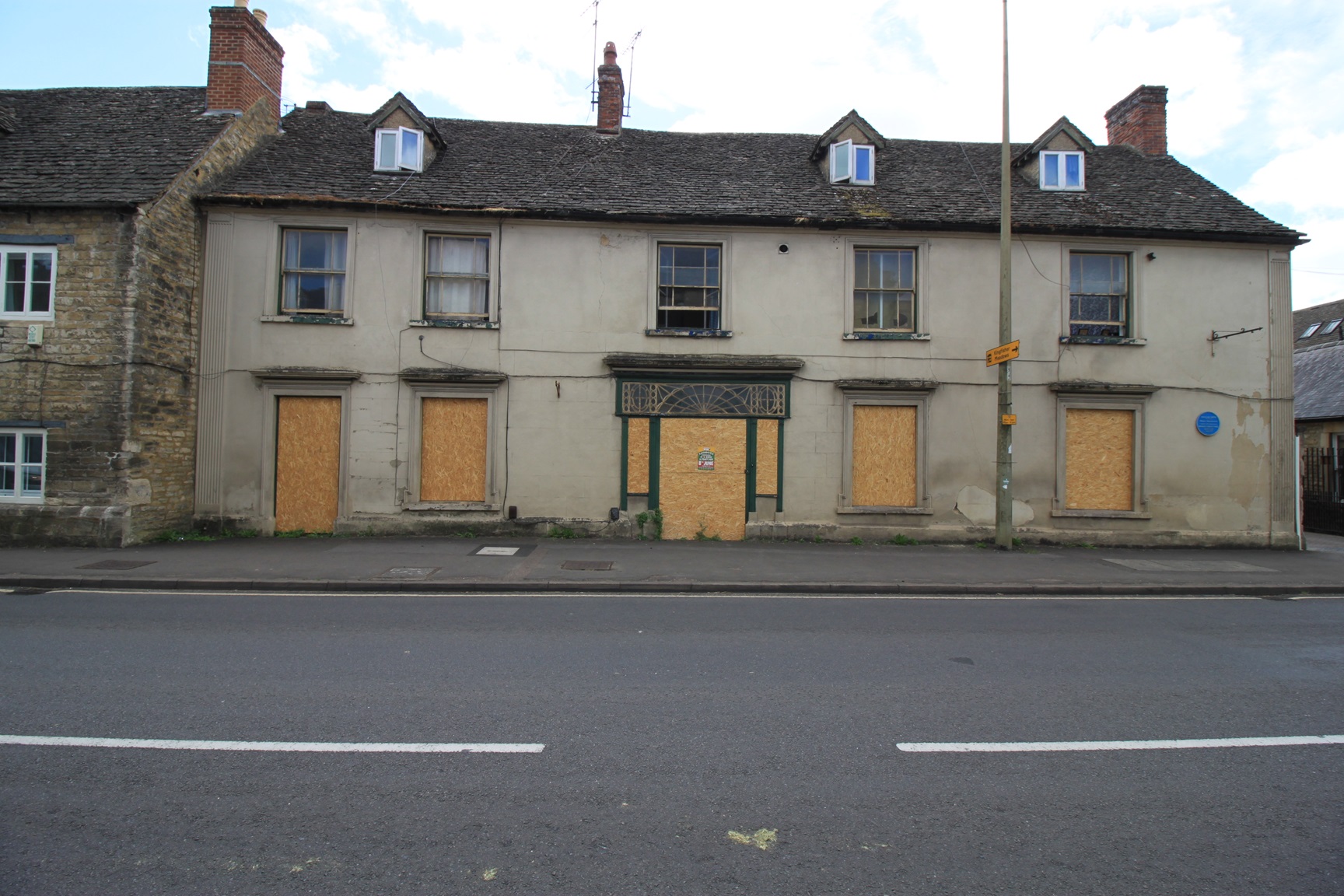
Bridge Street ran south from the market. It was wide, unusually wide for a street of its period, because it had once been the main route over the ford before the bridge was built, and the traffic that used it needed room. The buildings that grew up along it reflected the prosperity of the trade it served. Stone frontages. Sash windows. Houses that announced their owners had money and wanted that known.
Number 8 was one of these houses. Its origins are in the seventeenth century, though it was refronted around 1780 in the Georgian style that was by then the architectural language of ambition. The Historic England listing records what survived that refronting: coursed limestone rubble behind the stucco façade, a gabled stone slate roof, and at the entrance, the feature that still stops people on the pavement today, an elaborate decorative overlight with a central fanlight, flanked by pilasters, announcing whoever lived here as someone of consequence.
The building stood at the junction of the old wool town and the new industrial one. Behind it, the river. Beyond the river, the mills. Around it, the streets that had been laid out for a medieval market and now found themselves at the centre of something rather larger than anyone had planned.
This is the world that William Smith was born into, in Witney, on the thirteenth of August 1815.