
Chapter Two: The Man From Bridge Street
He wrote about himself only once, in a memoir composed in 1872, three years before his death. He was not a man who put himself forward. He stated the facts plainly and moved on.
William Smith was born on the thirteenth of August 1815, in the town of Witney, in the county of Oxford. He was, as he put it himself, left in infancy to the care of an aged grandfather and his sister with no other friend or relation to assist. His parents do not appear in the memoir. They are gone before the first sentence is finished.
He went to work early. He became an errand boy in the blanket trade, then a spooler, then a yarn weigher. He learned the weight of wool by handling it. He learned the blanket business from the bottom, moving through each stage of it, packer, weigher, the man who stood at the door of the warehouse and knew what was going in and what was coming out, until he was in charge of blanket dispatch for one of the town's established manufacturers.
Then he left.
For a time he became a brewer. He took on the retail licence at the White Hart Inn on Bridge Street, which tells you something about the man, a staunch Methodist who spent twenty-five years playing in the Witney Temperance Band, and yet at some point in his career he ran a pub. He is not embarrassed about it in the memoir. He states it and moves on.
Around 1851 he set up in business on his own. He started on the High Street, in premises that no longer exist. He used a donkey-powered spinning machine in the early years. The donkey is not mentioned in the memoir but the Witney Blanket Story archive has it. A man who had been an errand boy and a spooler and a packer and a pub landlord, now running his own business with a donkey turning the wheel.
He had a talent for contracts. He secured a government order for 125,000 mops. The mops brought him his first real money and his first public identity, he was known in the town for the rest of his life as the Great Mop-Maker of Bridge Street. He did not mind. He was building something larger than mops.
In 1857 he installed the first steam engine in the Witney blanket industry. At his High Street premises, before the Bridge Street mill existed, he was already the man who had decided that water power and donkeys were no longer enough. Steam was coming everywhere and William Smith intended to be first.
By the 1860s he had moved to Bridge Street. He had built his mill, not converted something, not adapted an existing structure, but purpose-built a steam-powered weaving mill on the east side of Bridge Street on the north bank of the Windrush, next to the house where he lived. The Bridge Street Mill. It sited itself very close to the river but it never used the river's power. That was William Smith's policy from the start. He had chosen steam and he would not go back.
He lived at number 8, in the Georgian house with the fanlight above the door. He could walk from his front door to his mill in perhaps thirty seconds. He could hear it from his bedroom. He died in the house in 1875, sixty years old, having spent the last quarter century of his life building the thing that ran next door.
The plaque went up on the wall of 8 Bridge Street on the twenty-fourth of April 2009. David Cameron, then Member of Parliament for Witney, unveiled it. The Blue Plaque records what mattered: blanket manufacturer, founder of the steam-powered Bridge Street Mill, resident of this house from approximately 1850 to 1875.
The mill continued without him. It changed hands, merged with other firms, wove blankets through two world wars and survived both, stopped weaving during the Second World War and started again, produced up to 450,000 blankets a year towards the end of its working life, and finally closed in 1975 when the market for traditional blankets collapsed. The building that fronts Bridge Street was converted into flats and offices in 2004.
The house where William Smith lived, number 8, the house with the fanlight, became a funeral parlour. Green's Funeral Services. It served the Witney community for generations from that address, the last business to occupy the building before we arrived.
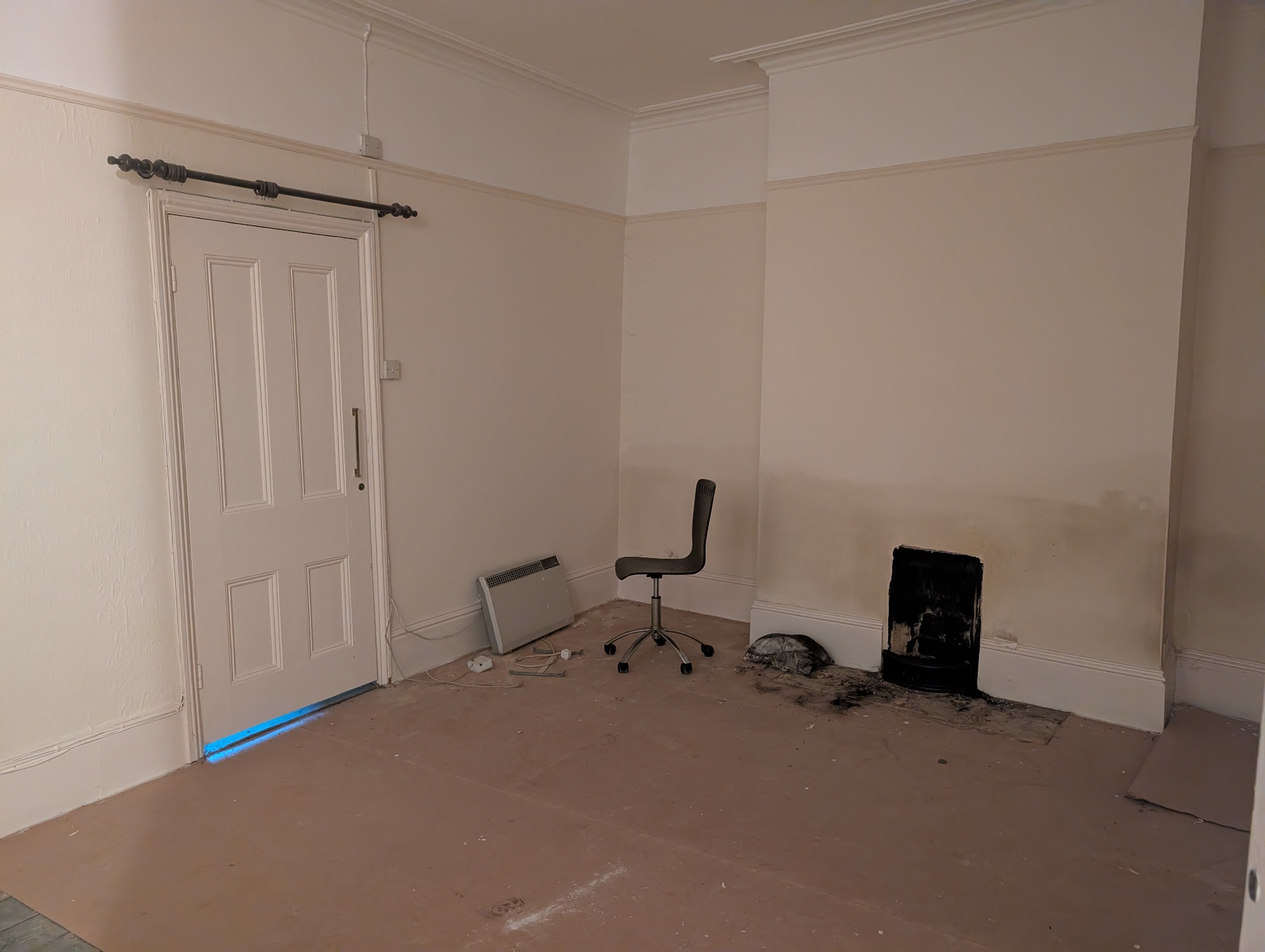
When we first walked through the door, the inglenook fireplace was still there. The Victorian tessellated floor. The plasterwork dated 1717, older than William Smith, older than the Georgian refronting, carrying its date in the stone as if it had been waiting for someone to notice. The building had not forgotten what it was. It had simply been waiting for someone to ask.